The EEU is Killing the GERD: How One Incompetent Utility Company is Sabotaging Ethiopia’s Future
- #Opinion
- #Ethiopia
- #Energy
- #Infrastructure
Is the Ethiopian Electric Utility actually a service provider, or is it a systemic chokehold masquerading as one? An essay on Ethiopia's energy crisis.
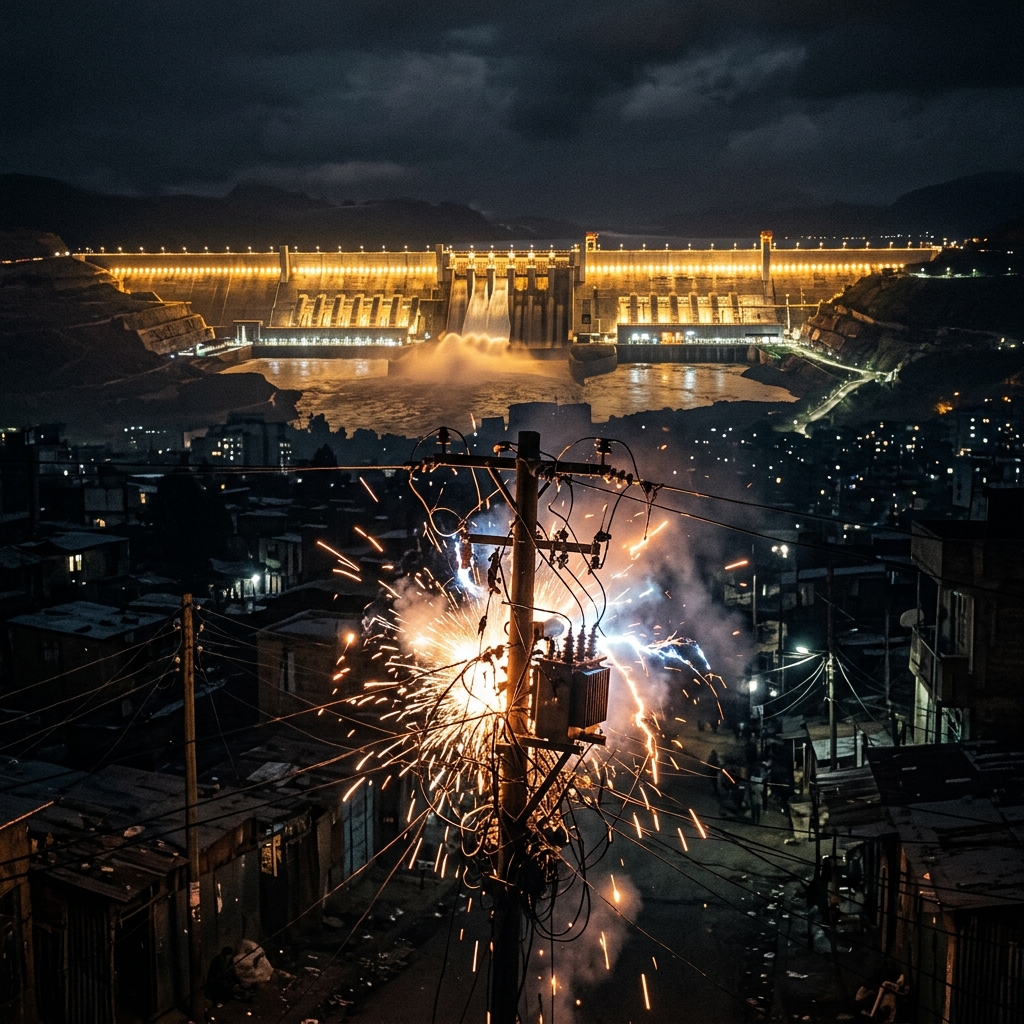
If you live in Addis Ababa, Adama or any growing Ethiopian town, you are intimately familiar with a specific sound: the collective, frustrated groan of a neighborhood as the lights flicker and die or the surreal, frantic applause and cheer that follows when they return, as if we are medieval peasants celebrating a miracle rather than citizens receiving a service we already paid for.
There is a profound irony in this daily ritual. We are told, with justified national pride, that Ethiopia is an energy superpower. We have the Grand Ethiopian Renaissance Dam (GERD), a concrete marvel of self-reliance. We have some of the lowest electricity tariffs. Yet, we live in a country where you cannot keep a phone charging, let alone a high-precision factory, a server rack or a modern office, without a backup plan.
The question we must ask is: Is the Ethiopian Electric Utility (EEU) actually a service provider, or is it a systemic chokehold masquerading as one?
The Generation-Distribution Gap
To understand why our grid is failing, we have to look past the grand dams. We have spent billions of dollars on “Generation”, massive projects that are visible symbols of progress. But we have neglected the “Distribution”, the transformers, the relays, and the local wires that actually bring that progress to our doorsteps.
In engineering terms, this is a massive mismatch in system capacity. You can produce all the power in the world, but if your distribution network is a leaking bucket, the user at the end of the line gets nothing but a “Voltage Sag” that fries their expensive equipment. We have built the heart of a giant, but the veins are too narrow and brittle to carry the blood.
The Lethargy of the Monopoly
The real “chokehold” on Ethiopia isn’t a lack of water in our dams; it is the institutional laziness of a state-protected monopoly. Because the EEU has no competitors, it has no incentive for precision.
In a functioning economy, if a transformer in a busy industrial zone starts making an abnormal humming sound, it is a signal for preventative maintenance. In the EEU’s world, that sound is ignored until the transformer literally explodes. Only when the hardware is a charred remains does the bureaucracy move.
The “laziness” of the EEU is exacerbated by the fact that they are operating blindly. While the rest of the modern world uses automated sensors and real-time “Smart Grids” to detect faults before and after they happen, our utility seems to rely on the “phone-call-and-guesswork” method.
I recall a transformer exploding in my neighborhood, a violent, blue flash that plunged several blocks into darkness. I did what any responsible citizen would do: I called the EEU. This wasn’t my first time, but the conversation remains etched in my mind for its sheer absurdity. Despite being the national utility, they had no idea which transformer had blown. I gave them the kebele, the specific street, and even the landmarks it sat between. They kept asking for the “exact location,” revealing a terrifying truth: The EEU doesn’t even know where their own transformers are. In a world where you can track a food delivery across a city in real-time, our multi-billion-birr power utility cannot locate its own critical infrastructure on a map. You cannot manage what you do not measure, and you certainly cannot fix what you cannot find.
This “reactive” culture is a silent killer of productivity. When the power goes out twice a day as it does in my neighborhood, a factory manager cannot automate. You cannot set a 24-hour production cycle. You cannot trust your cooling systems. As a result, every Ethiopian business is forced to pay a “Reliability Tax.” They must buy their machinery twice, once for the electric version and once for the generator. We are exporting coffee to earn dollars, only to turn around and spend those dollars on imported fuel to power generators that shouldn’t need to exist.
The Illusion of “Cheap”
The government often points to our low tariffs as a win for the poor and even threatens to charge more. But “cheap” power that isn’t there is the most expensive thing in the world.
Consider a small business owner in Addis. On paper, their electricity bill is negligible. In reality, their costs are astronomical. They lose inventory when refrigerators fail; they lose work hours when the lights go out; and they lose customers when they can’t provide basic services, And with the current gas prices most even can’t run generators.
The current system rewards the EEU for simply existing, rather than for delivering. We are subsidizing failure. A slightly higher tariff that guaranteed near-perfect reliability would be infinitely cheaper for the Ethiopian economy than the current “low-cost” chaos.
The Prescription: Decentralize or Decay
How do we fix a system that seems to prefer darkness? We must move away from the culture of central control and manual overrides.
Break the Grid: The EEU should not own the “Last Mile.” We must allow private companies or industrial cooperatives to manage their own local distribution. If a factory park in Modjo wants to hire a specialized firm to maintain its own transformers and guarantee 100% uptime, the law should get out of their way.
Modernize the Infrastructure Logic: We need to treat the grid as a precision network. Every transformer should be equipped with sensors that track health in real-time as. The developed world have been doing this for decades and even developing countries like in West Africa have moved on to Smart grids and we should follow their lead
Legalize Local Generation: We need to allow for “Net Metering.” If a citizen or a business puts solar panels on their roof, they should be able to feed that power back into the grid. This turns the entire city into a distributed energy source, stabilizing the voltage for everyone and reducing the load on the EEU’s crumbling substations. More importantly, this policy would lay the foundation for a new class of independent power producers at the neighborhood and industrial level. Over time, private firms, cooperatives, and even communities could generate and manage localized power supply, introducing competition, at least at the distribution edge where none currently exists. This shift would not only improve reliability but also incentivize innovation and accountability in a sector that has long operated without both.
Conclusion: Lighting the Future
Ethiopia cannot “dam” its way out of poverty if the wires that carry that power are controlled by an institution that treats uptime as an afterthought.
The GERD is a beautiful achievement and the pride of every Ethiopian, but it is only half the job. The real revolution will happen when the “Light Show” stops - when the groan of the neighborhood is replaced by the silent, steady hum of a grid that actually works. We have the power; now we just need the institutional will to move it.